
🔥 Today's Offer: Apply for any credit card & get ₹500 extra cashbackApply Now →

How to Choose the Right Credit Card in India (2026 Guide)

Select a card by matching its rewards to your biggest monthly expenses, not just the welcome bonus.

Nisha S· Senior Finance Editor·Published 7 Aug 2026, 8:57 pm IST·Updated 7 Aug 2026, 8:30 pm IST·9 min read·Last reviewed 7 Aug 2026
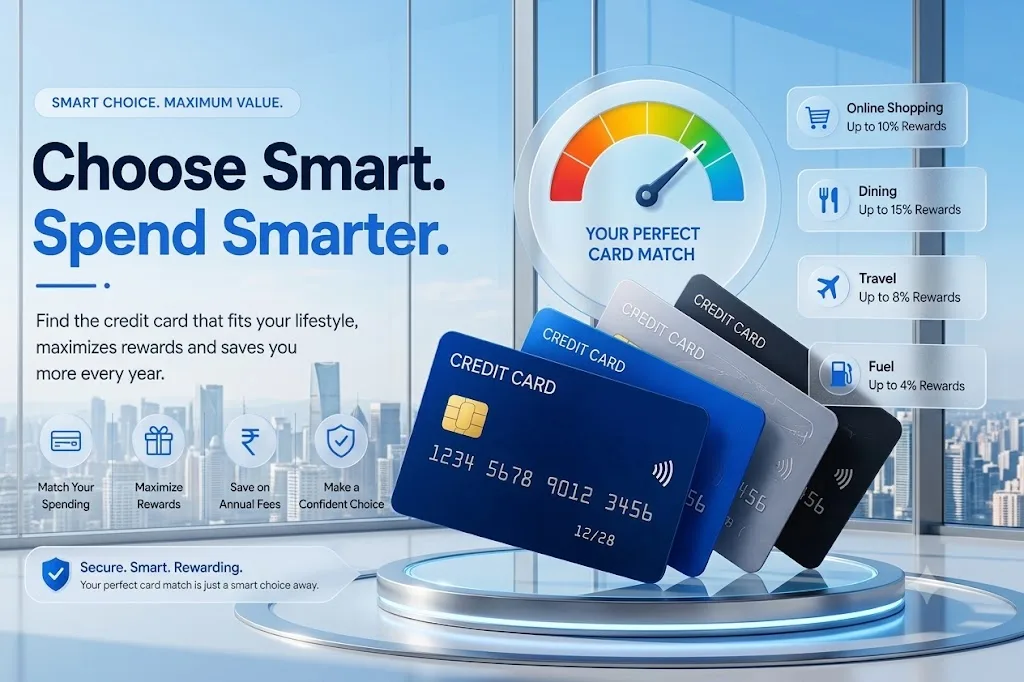
Credit cards with a rewards meter showing your perfect card match

At a Glance

Category
Personal Finance
Type
Guides
Difficulty
beginner
Reading time
9 min read
Last reviewed
7 Aug 2026

Best for

  • First-time credit card applicants
  • Salaried professionals
  • Students with an education loan
  • Users looking to get a second, more rewarding card
Share:

Key takeaways

  • Analyse your bank and UPI statements to identify your top 3 spending categories before choosing a card.
  • Match your largest expense (e.g., travel, online shopping, fuel) to a card that rewards that specific category.
  • Calculate the annual fee break-even spend to see if a paid card is worth it for you.
  • Always check for monthly reward caps and excluded categories like rent or wallet loads.
  • For international travel, prioritise cards with low foreign exchange markup fees over just lounge access.
  • Use a lifetime-free card if you are a first-time user or have low monthly spending.

Choose a credit card by matching its primary reward category—like cashback, travel, or fuel—to your single largest area of monthly spending.

At a Glance: Choosing Your Card

Your choice depends on three factors: your lifestyle, the features you need, and the fees you are willing to pay. The right card for you will offer maximum value on your routine expenses, whether that is buying groceries, booking flights, or paying for fuel.

Key Steps to Select a Credit Card
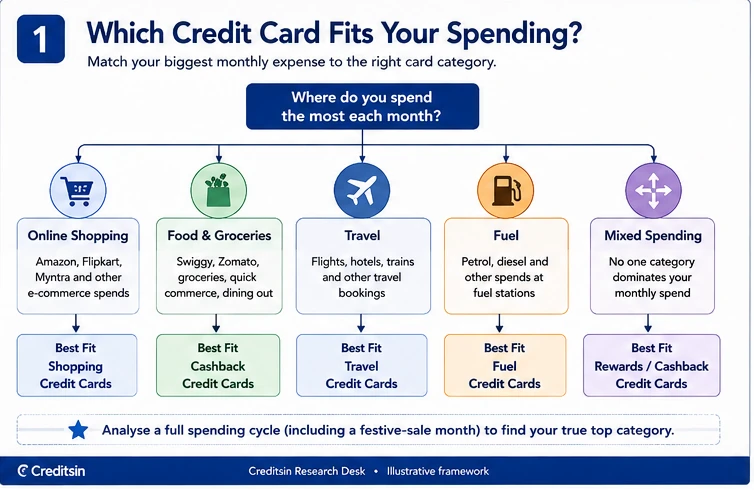
Decision map: which credit card category fits your biggest monthly spending

Banks segment cards around specific spending behaviours, so the first job is to work out which behaviour is actually yours — not which card looks most impressive.

Step 1: Analyse Your Spending Habits

Review your recent bank and UPI statements covering a full spending cycle, including at least one festive-sale month. Categorise your spending into buckets:

  • Online Shopping: Amazon, Flipkart, Myntra
  • Food & Groceries: Swiggy, Zomato, Blinkit, Zepto
  • Travel: Flights (IRCTC, airlines), hotels, trains
  • Fuel: Petrol/Diesel expenses
  • Utilities & Rent: Bill payments, rent payments via apps
  • Large Purchases: Electronics, school fees, insurance premiums
  • Step 2: Compare Reward Types

    Once you know where your money goes, match it to a reward structure.

  • Cashback: Direct money credited to your statement. Best for simplicity and predictable value on everyday spending.
  • Reward Points: Points earned per rupee spent. Offers flexibility to redeem for vouchers, merchandise, or sometimes, cash. Value per point can vary.
  • Travel Miles: Co-branded cards with airlines or travel portals. Best for frequent flyers who are loyal to a specific airline or ecosystem.
  • Step 3: Evaluate Fees and Charges

    Understand the costs involved before you apply.

  • Annual Fee: A yearly charge for holding the card, and taxes usually apply on top of it. A costlier card normally carries a longer benefit list, but a benefit is worth something only if you actually use it. Lounge visits you never make and vouchers you never redeem are worth nothing to you.
  • Interest Rate (APR): Charged on the outstanding balance if you do not pay the full amount by the due date.
  • Foreign Exchange (Forex) Markup Fee: A percentage charged on all international transactions.
  • Spending Example: Two Lifestyles, Same Budget
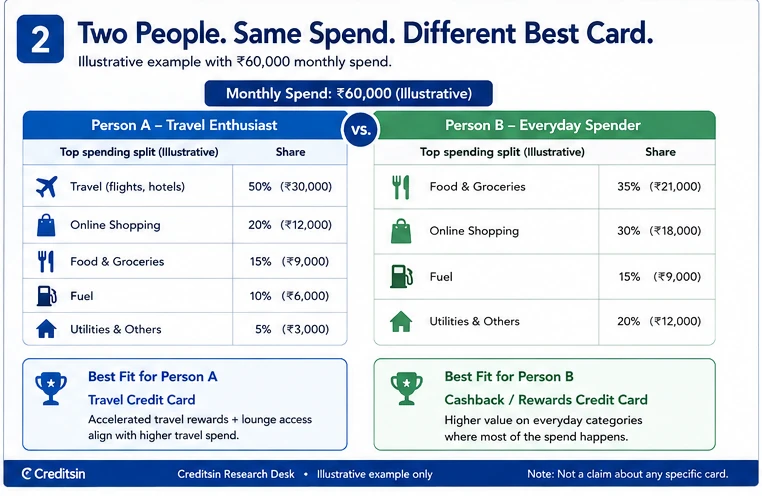
    Illustrative comparison: two people with the same monthly spend need different best-fit cards
    Illustrative comparison: two people with the same monthly spend need different best-fit cards

    Consider two people, both spending ₹60,000 a month.

    (Illustrative Example)

    Expense CategoryPerson A (Online Shopper)Person B (Frequent Traveller)
    Online Shopping/Food₹25,000₹5,000
    Flights & Hotels₹5,000₹30,000
    Fuel₹5,000₹5,000
    Groceries & Utilities₹20,000₹15,000
    Other Spends₹5,000₹5,000
    Total Spend₹60,000₹60,000
  • Best Card for Person A: A cashback card offering a high rate on online spending. If a card gives 5% cashback (illustrative) on online shopping, Person A earns ₹1,250 per month on that category alone.
  • Best Card for Person B: A travel credit card. This card might offer accelerated miles on travel bookings, complimentary lounge access, and a lower forex markup fee, providing more value than simple cashback would on their ₹30,000 travel spend.
  • A Rough Break-Even Check on the Annual Fee
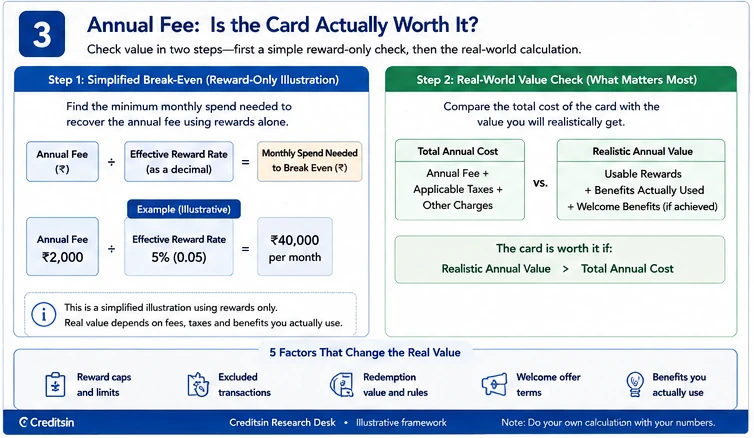
    Annual fee break-even check and the real-world value comparison
    Annual fee break-even check and the real-world value comparison

    Before paying an annual fee, it helps to sanity-check whether rewards alone can cover it. One simplified, reward-only arithmetic is:

    `Annual Fee / Reward Rate (%) = Spend Needed for Rewards Alone to Match the Fee`

    Example (illustrative): if a card carries a ₹1,000 annual fee and returns an average 1.5% (illustrative) in rewards, you would need to put roughly ₹66,667 through it in a year for rewards alone to match the fee.

    `₹1,000 / 0.015 = ₹66,667`

    Treat that number as a starting point, not a verdict. It is a reward-only illustration and it ignores most of what actually decides whether a card is worth holding. The fuller comparison is:

    Joining and annual fee, plus applicable taxes against reward value you can realistically use, plus benefits you will genuinely use.

    The effective value of the same reward rate changes from person to person because of:

  • Spending categories: the headline rate often applies only to some categories, and everything else earns the base rate.
  • Reward caps: monthly or annual limits stop the accelerated rate once you cross them.
  • Excluded transactions: several categories may earn nothing at all.
  • Point valuation: a point is not a rupee, and its worth depends on what you convert it into.
  • Redemption rules: minimum thresholds, expiry, partner-only transfers and handling charges all reduce what lands in your hands.
  • Understanding Reward Caps and Exclusions

    A high reward rate is often limited by a monthly cap, so the headline rate only applies up to a fixed amount of spending each month. Take a card paying 5% cashback on utility bills capped at ₹150 a month (illustrative): once your utility spending crosses ₹3,000 in that month (illustrative), the extra spend earns nothing more. Read the card's Most Important Terms and Conditions for the exact cap on each category. Also, check for excluded categories like wallet loads, fuel, and rent payments, which often earn no points or cashback.

    Don't Choose a Card Only by the Headline Reward Rate
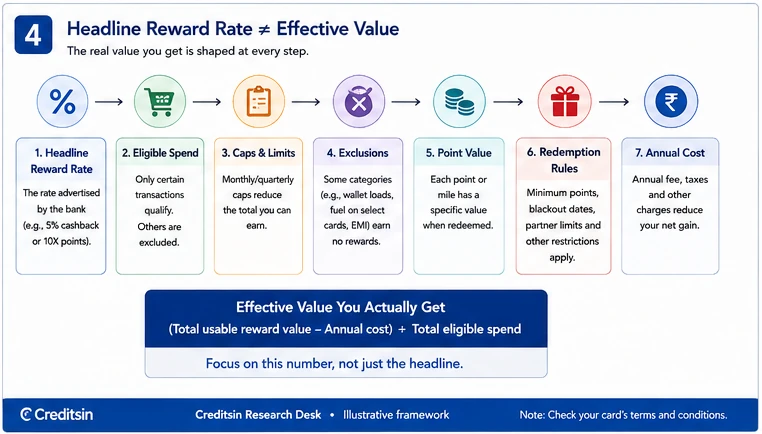
    Headline reward rate versus effective value: the seven steps that reduce what you actually earn
    Headline reward rate versus effective value: the seven steps that reduce what you actually earn

    The number on the advertisement is the starting point of a chain, not the end of it. Follow the chain before you apply:

    Headline reward rate — the figure the card is marketed on.

    Eligible spending — does that rate apply to where your money actually goes, or only to a narrow category?

    Reward cap — does the accelerated rate stop after a monthly or annual limit?

    Excluded transactions — which of your regular payments earn nothing?

    Point or redemption value — what is a point actually worth when you convert it?

    Redemption restrictions — expiry, minimum thresholds, partner-only options, handling charges.

    Annual cost — the fee plus applicable taxes you pay to keep the card.

    What survives at the end of that chain is your real effective value. Two people holding the same card can end up in very different places, because one spends inside the rewarded categories and redeems sensibly, while the other spends mostly on excluded transactions and lets points lapse. Work the chain on your own numbers before the reward rate convinces you.

    How Spend-Based Fee Waivers Work

    Many cards with annual fees offer a waiver if you spend a certain amount in the previous year. For example, a card with a ₹500 annual fee might waive it if your total spending crosses ₹1,00,000. Some banks also offer cards with no annual fee based on their eligibility criteria.

    Valuing Lounge Access and Travel Benefits

    For travellers, premium cards offer benefits that can outweigh a high annual fee. Domestic lounge access is a common perk. International travellers should look for cards with complimentary Priority Pass access and a low foreign exchange markup fee, as this can save a significant amount on overseas spending.

    The Foreign Exchange (Forex) Markup Fee

    When you use your card abroad or on an international website, your bank charges a forex markup fee on the transaction amount. This typically ranges from 2% to 4% (illustrative). A premium travel card might offer a lower rate, saving you money on every international purchase.

    UPI and RuPay Credit Cards

    Some credit cards issued on the RuPay network can be linked inside a UPI app and used to scan and pay at merchants, which extends card payments to small shops that accept UPI QR codes but do not have a card machine. The facility is not uniform: whether your particular card is eligible, which UPI apps support it, which merchant categories are permitted, and whether these payments earn rewards are all set by your card issuer. Check your issuer's own terms for your specific card before assuming a UPI payment will behave like a normal card swipe.

    Fuel Surcharge and Co-branded Cards

    Fuel is charged differently. SBI Card's Most Important Terms and Conditions list a surcharge of 1% of the transaction amount plus applicable taxes on petrol and all products sold at petrol pumps, and note that the surcharge is levied by the acquiring bank that provides the terminal, not by the card issuer. Many cards refund that surcharge only inside a transaction band. Axis Bank's MITC lists a fuel transaction surcharge of 1% of transaction amount, refunded for fuel transactions between INR 400 to INR 4,000, only at authorized IndianOil outlets. If fuel is a major expense, consider a co-branded fuel credit card which provides enhanced rewards at specific fuel stations like HPCL, BPCL, or IndianOil.

    Who Should Choose Which Card Type?

  • Cashback Cards: Best for those with high, consistent spending on online shopping, groceries, and utility bills. Ideal for users who want simple, automatic savings.
  • Travel & Miles Cards: Best for frequent flyers and hotel guests. The value comes from accelerated miles, lounge access, and lower forex fees.
  • Reward Points Cards: Good for users who want flexibility. Points can be redeemed for flights, hotels, merchandise, or gift vouchers. Best suited for those who track redemption values.
  • Beginner/Lifetime-Free Cards: Excellent for first-time users or those with low spending. They help build a credit history without the pressure of an annual fee.
  • Common Mistakes to Avoid

    A few habits quietly cost people more than the card ever returns.

  • Applying for a card because of the welcome offer. The joining gift lasts a few weeks; the reward structure and the fee stay with you for years. Judge the card on month thirteen, not month one.
  • Paying for benefits you never use. Lounge visits, concierge desks, golf rounds and partner vouchers only count if they appear in your actual life. Anything you would not have bought anyway is not a saving.
  • Ignoring caps and excluded categories. The advertised rate often applies to a narrow slice of spending and stops at a monthly limit. Read the Most Important Terms and Conditions before you assume your spending qualifies.
  • Applying without checking eligibility first. Each application leaves a footprint on your credit record. Read the issuer's stated criteria for that specific card, and apply where you have a realistic case.
  • Spending extra just to hit a fee-waiver threshold. Chasing a waiver by buying things you did not need costs more than the fee you avoided.
  • Paying only the minimum due each month. It keeps the account current and nothing more — the rest of the balance keeps accruing interest, and the repayment stretches out.
  • Choosing the wrong category for how you actually spend. A travel card in the hands of someone who rarely travels, or a fuel card for someone who commutes by metro, underperforms a plain card. Match the card to your statement, not to your aspirations.
  • Eligibility and How to Apply

    Standard eligibility criteria in India include your age, Indian residency, a stable income, and a healthy credit history. The online application process is straightforward:

    1. Compare Cards: Use online tools to filter cards based on your needs.

    2. Fill Application: Complete the online form on the bank's website.

    3. Upload Documents: Submit digital copies of your KYC documents (PAN, Aadhaar) and income proof.

    4. Video Verification: Complete a short video call (vKYC) to verify your identity.

    Upon approval, the bank sets your credit limit, which is the maximum amount you can spend on the card.

    Frequently asked questions

    What credit score do I need for a credit card in India?

    Issuers do not publish a single cut-off, and each one runs its own credit policy, so no fixed number guarantees approval. A longer, cleaner repayment record and low existing credit usage help; recent defaults, high utilisation and a burst of fresh applications hurt. If you have no credit history at all, an entry-level card or a secured card backed by a fixed deposit is the usual starting point. Check the eligibility page of the specific card you want rather than relying on a general score figure.

    Can I get a credit card without a salary slip or ITR?

    Often yes. Banks frequently offer cards to their existing customers on the strength of the banking relationship — balances and transaction history — instead of income documents. The other route is a secured credit card issued against a fixed deposit, where the deposit acts as collateral. The limit assigned against the deposit varies by issuer, so confirm it with the bank before opening the deposit. Both routes are practical ways to build a credit history from scratch.

    What is the difference between a welcome bonus and regular rewards?

    A welcome or joining bonus is a one-time offer for new cardholders, usually released only after you spend a stated amount within a stated window from card set-up. Regular rewards are what you keep earning on every eligible transaction for as long as you hold the card. Before you let a welcome bonus decide the application, check whether the required spend is something you would have spent anyway, and read what the card returns in month thirteen — that is the part you live with.

    How does a 'lifetime-free' credit card work?

    A lifetime-free card carries no joining fee and no annual fee for as long as you hold it. It is not a free-of-cost card: interest on revolved balances, late payment charges, foreign exchange markup and cash withdrawal charges still apply. The Reserve Bank's directions on credit cards are explicit that there shall not be any hidden charges while issuing credit cards free of charge, so every applicable charge must be disclosed to you in writing. Read the schedule of charges even on a free card.

    What happens if I only pay the minimum amount due on my bill?

    The Reserve Bank defines the minimum amount due as the minimum part of the total bill you must pay so the bill is not treated as overdue. Paying only that keeps the account current, but the rest of the balance stays outstanding and attracts interest. RBI requires issuers to print a warning on every statement to the effect that making only the minimum payment every month would result in the repayment stretching over months or years with consequential compounded interest payment on your outstanding balance. Treat the minimum as an emergency measure, not a payment plan.

    Should I get a co-branded credit card?

    A co-branded card makes sense when a large and steady share of your monthly budget goes to that one brand, platform or fuel company, because the accelerated rewards are concentrated there. The trade-off is that spending outside the partner ecosystem usually earns the base rate. Compare the extra you would earn inside the ecosystem against what a broad-based card would have returned across all your spending, and read the card's own terms for the categories that are excluded.

    Can I use my credit card to pay rent?

    Several third-party apps let you pay rent by credit card, but the economics rarely work in your favour. These platforms charge a convenience fee on the transaction, and many issuers now exclude rent payments from reward earning or cap them tightly. Before using one, check the fee the platform charges and your card's terms on rent transactions — if rent earns no rewards and the platform takes a cut, you are simply paying to move money.

    About the author

    Nisha S

    Senior Finance Editor

    Nisha leads editorial coverage of credit cards, lending and RBI policy at Creditsin News, focusing on how rule changes affect everyday borrowers.

    editor@creditsin.com

    Creditsin News follows our editorial policy, fact-check standards and corrections policy.

    Not editorial

    Product listings are separate from our reporting. Creditsin may earn a referral fee if you apply through these pages.

    Editorial disclaimer

    This article is for information only and is not financial advice. Approval, rates, fees and features depend on bank/NBFC policies, eligibility and successful verification. Details were accurate at the time of review — always confirm current terms on the lender's official page.

    Commercial disclosure

    Creditsin may earn a referral commission when you apply for a product through links on this site. Commercial relationships never influence our editorial coverage, rankings or recommendations. Read our editorial policy.

    Spot an error? Write to corrections@creditsin.in or visit the newsroom contact page. About Creditsin News.