
🔥 Today's Offer: Apply for any credit card & get ₹500 extra cashbackApply Now →
Credit CardsExplainers

How Credit Card Interest is Calculated in India

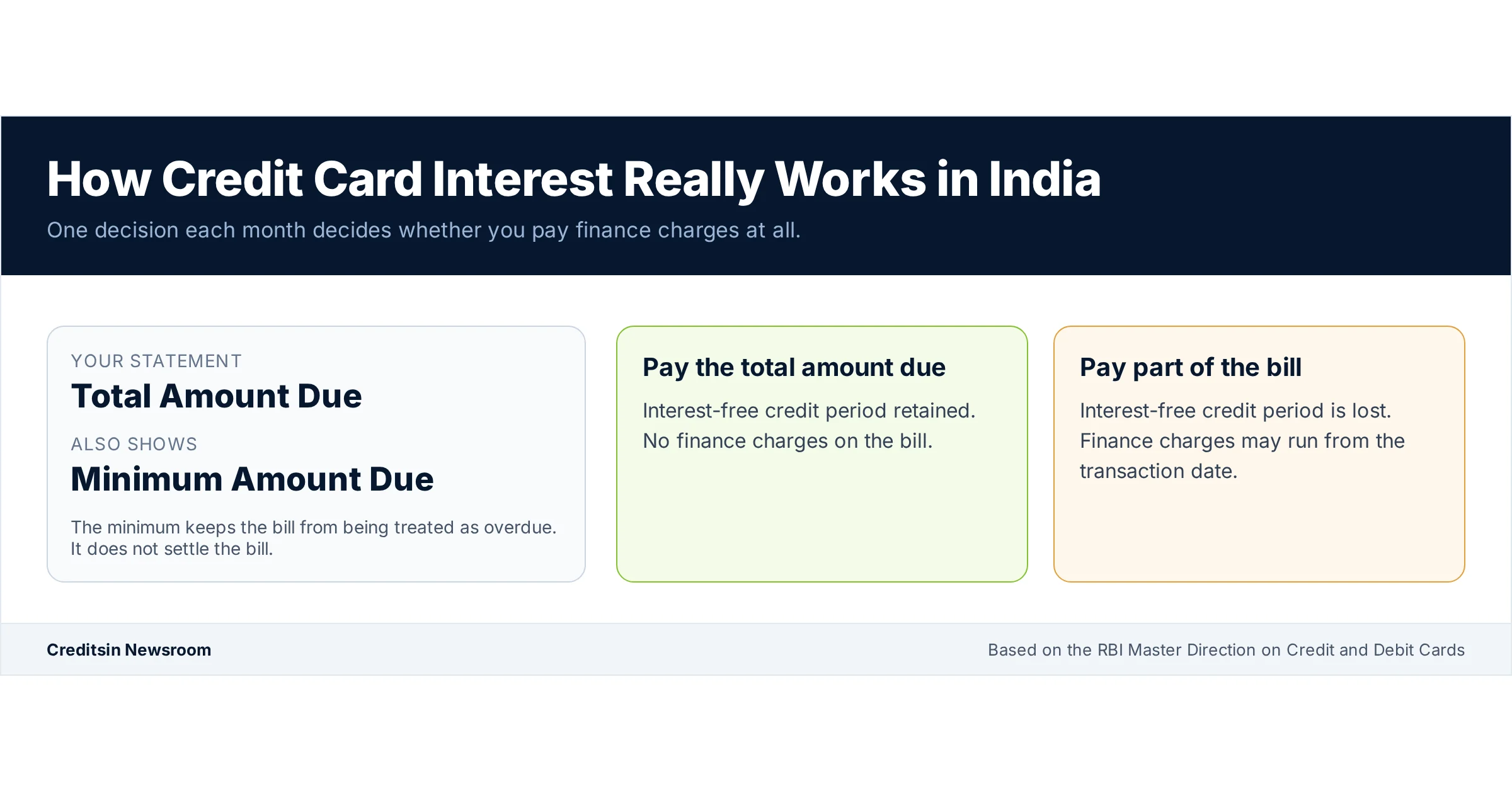
Clear the full bill by the due date and you pay nothing. Miss it, and charges can run from the transaction date.

Nisha S· Senior Finance Editor·Published 8 Aug 2026, 2:33 pm IST·10 min read·Last reviewed 8 Aug 2026
How credit card interest really works in India: paying the total amount due keeps the interest-free credit period, paying part of the bill loses it

At a Glance

Category
Credit Cards
Type
Explainers
Difficulty
beginner
Reading time
10 min read
Last reviewed
8 Aug 2026

Best for

  • First-time credit card users
  • Anyone carrying a revolving balance
  • Readers comparing minimum vs full payment
  • Users planning a large card purchase
Share:

Key takeaways

  • Interest applies only when the total amount due is not paid in full by the payment due date.
  • Once the interest-free period is lost, interest may be levied from the transaction date on the outstanding amount.
  • Paying the Minimum Amount Due only prevents an overdue bill; it does not stop finance charges.
  • Finance-charge rates vary by issuer, card and transaction type - check your MITC and schedule of charges.
  • Cash withdrawals carry their own fee and finance charges, disclosed separately in the MITC.
  • RBI does not fix rates; it requires a board approved interest rate ceiling and full disclosure.

Pay your Total Amount Due in full by the payment due date and you pay no interest. Miss that, even by a partial payment, and interest can be charged from the date of each transaction rather than from the due date.

That single rule explains almost everything about credit card interest in India. The rest is arithmetic, timing and the terms your own issuer has published.

At a Glance

  • Interest applies only when the total amount due is not cleared by the payment due date.
  • Once the interest-free period is lost, interest may run from the transaction date on the outstanding amount.
  • Paying the Minimum Amount Due keeps the account from being treated as overdue; it does not stop finance charges.
  • Finance-charge rates differ by issuer, by card and by transaction type, so your card's MITC and current schedule of charges are the only reliable numbers.
  • Cash withdrawals are billed differently from purchases and carry their own fee and finance charges.
  • Key Takeaways

  • The full bill, not the minimum, is what protects you.
  • Interest is charged on the outstanding amount, not on the total billed amount.
  • Rates are not set by the regulator; they are set by each card-issuer within its own board approved ceiling.
  • The cheapest way to use a credit card is as a payment tool with a full monthly settlement.
  • When Credit Card Interest Is Charged

    Two situations trigger finance charges. You either pay nothing by the due date, or you pay something less than the full total amount due. ICICI Bank puts it plainly: interest comes into play when you do not pay the full outstanding balance by the due date, or when you pay only the minimum amount. IDFC FIRST Bank describes the same charge from the issuer's side, as interest levied on the overdue amount.

    Everything else people worry about, such as swiping too often or holding several cards, does not by itself create interest. Carrying a balance does.

    Understanding the Interest-Free Period
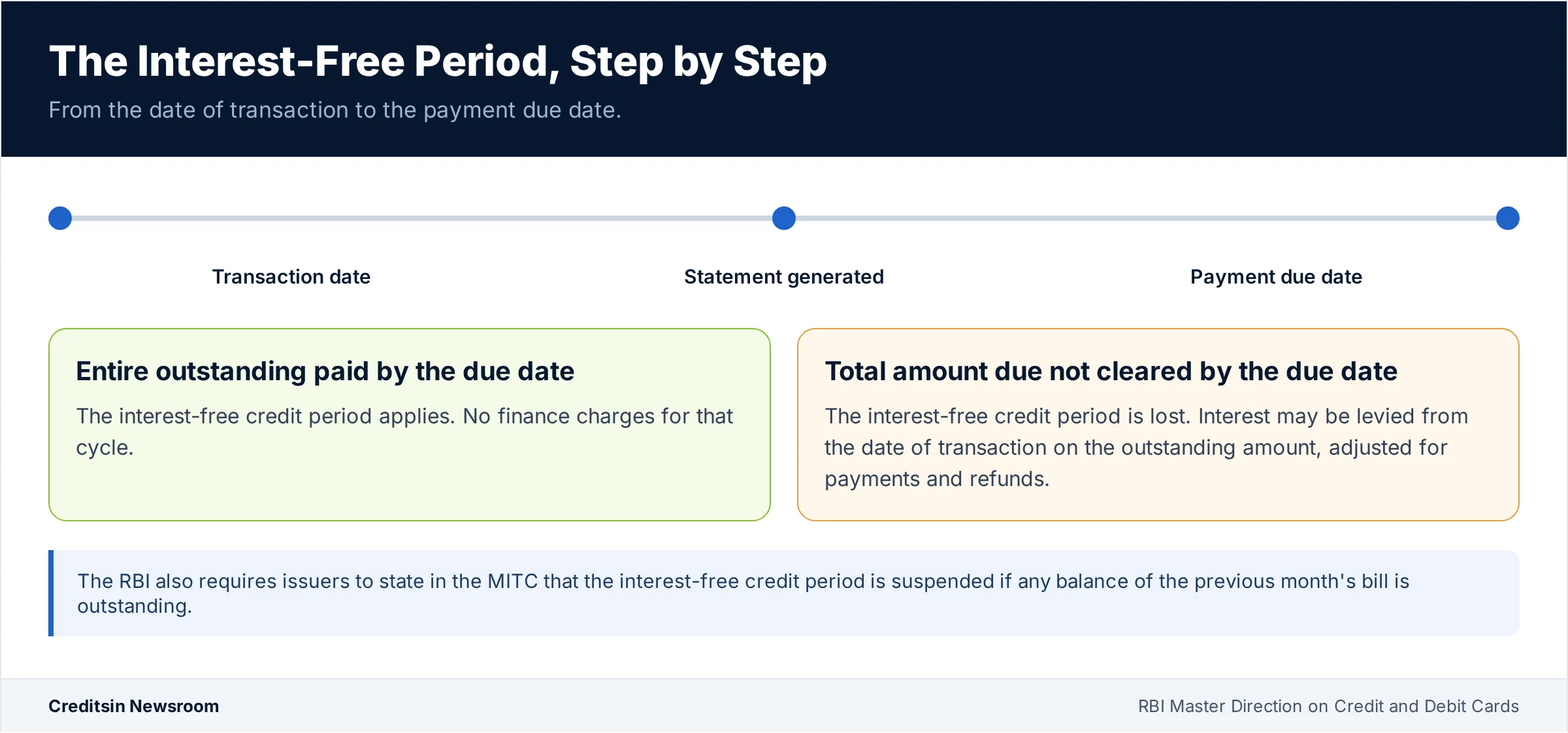
    Timeline of the interest-free credit period, from transaction date to statement date to payment due date, and what happens if the total amount due is not cleared
    Timeline of the interest-free credit period, from transaction date to statement date to payment due date, and what happens if the total amount due is not cleared

    The RBI's Master Direction on credit and debit cards defines the interest-free credit period as the period from the date of transaction to the due date of payment, and it is available only if the entire outstanding is paid on or before the payment due date.

    The catch sits in the word "entire". The RBI requires issuers to spell out in the MITC that the interest-free credit period is suspended if any balance of the previous month's bill is outstanding. So the grace period is not a permanent feature of the card. It is a monthly reward for settling in full, and it switches off the moment you carry something forward.

    The regulator is equally clear on what happens next. If the total amount due is not cleared within the payment due date, the interest free credit period is lost and interest may be levied from the date of transaction on the outstanding amount, adjusted for payments and refunds, and not on the total amount due. Two practical consequences follow. Older purchases can attract finance charges retrospectively from the day you made them, and fresh spends lose their grace period until the account is clean again.

    How Credit Card Interest Is Calculated

    Statements usually show a monthly rate, and issuers are required to disclose the annualised view as well. Under the Master Direction, card-issuers must quote Annualized Percentage Rates for different situations such as retail purchases, balance transfer, cash advances, non-payment of minimum amount due and late payment, where those rates differ. They must also indicate upfront the methodology of calculation of finance charges, with illustrative examples, particularly when only part of the outstanding is paid.

    This is why there is no single national credit card interest rate to quote. Your rate depends on your issuer, your card variant and the type of transaction. The number that matters to you is printed in your card's MITC and in the current schedule of charges on the issuer's website.

    The mechanics themselves are consistent. Finance charges are applied to the outstanding balance for the number of days it stays unpaid, which is why the transaction date, the statement date and the payment date all change the final figure. Taxes apply on the charges. Payments made mid-cycle reduce the balance from the day they are credited.
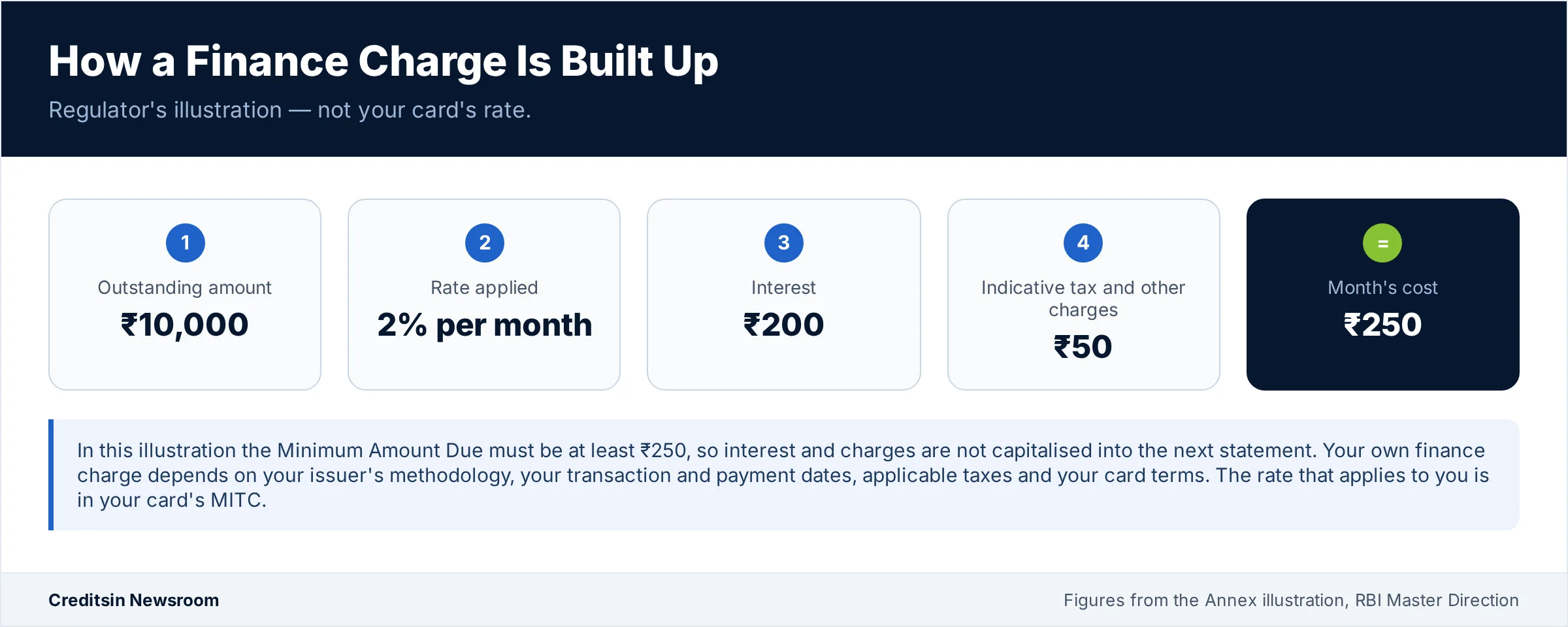
    Illustrative build-up of a monthly finance charge using the RBI annex example: ₹10,000 outstanding at 2% per month, ₹200 interest plus ₹50 indicative tax and other charges, totalling ₹250
    Illustrative build-up of a monthly finance charge using the RBI annex example: ₹10,000 outstanding at 2% per month, ₹200 interest plus ₹50 indicative tax and other charges, totalling ₹250

    Worked example (illustrative)

    The RBI's annex illustration shows the shape of a monthly interest calculation on an outstanding amount. An outstanding of ₹10,000 at a rate of 2% per month produces interest of ₹200, and with indicative tax and other charges of ₹50 the month's cost adds up to ₹250 on top of the outstanding. The Minimum Amount Due must be at least that ₹250 in the illustration, so that interest and charges are not capitalised into the next statement.

    Read it as teaching arithmetic, not as your card's rate. Your actual finance charge depends on your issuer's methodology, your transaction and payment dates, applicable taxes and the terms of your card.

    Total Amount Due vs Minimum Amount Due

    Every statement carries both figures, and they do very different jobs.

    The Minimum Amount Due is defined by the RBI as the minimum amount, as part of the total bill amount, that a cardholder has to pay so the bill is not treated as overdue. That is its entire purpose. It protects the account status. It does not settle the bill, and it does not stop finance charges on the balance you carry.

    The regulator is blunt enough about this that it mandates a warning on statements: making only the minimum payment every month would result in repayment stretching over months or years, with compounded interest on your outstanding balance. The same rules require that the minimum be structured so there is no negative amortization, and that unpaid charges, levies and taxes are not capitalised for charging or compounding interest.

    Two spending scenarios (illustrative)

    Person A and Person B both spend the same amount in a month and both receive the same bill.

  • Person A pays the total amount due before the payment due date. Finance charges: nil. The grace period stays intact next month.
  • Person B pays only the minimum. The account is not overdue, but finance charges begin on the outstanding, and the interest-free period is suspended until the balance is fully cleared.
  • Same card, same spending, very different cost. The difference is behaviour, not the product.

    What Happens to New Purchases After You Revolve

    This is the part most people discover late. Once a previous month's balance is outstanding, new purchases no longer enjoy the grace period, because the interest-free credit period stands suspended while that balance exists. Fresh spends start attracting finance charges, and the only reliable exit is to bring the outstanding to zero and let the next full cycle reset the grace period.

    Practically, that means a revolving balance is not a one-month problem. It quietly raises the cost of everything you buy until it is cleared.

    Cash Withdrawals vs Purchases
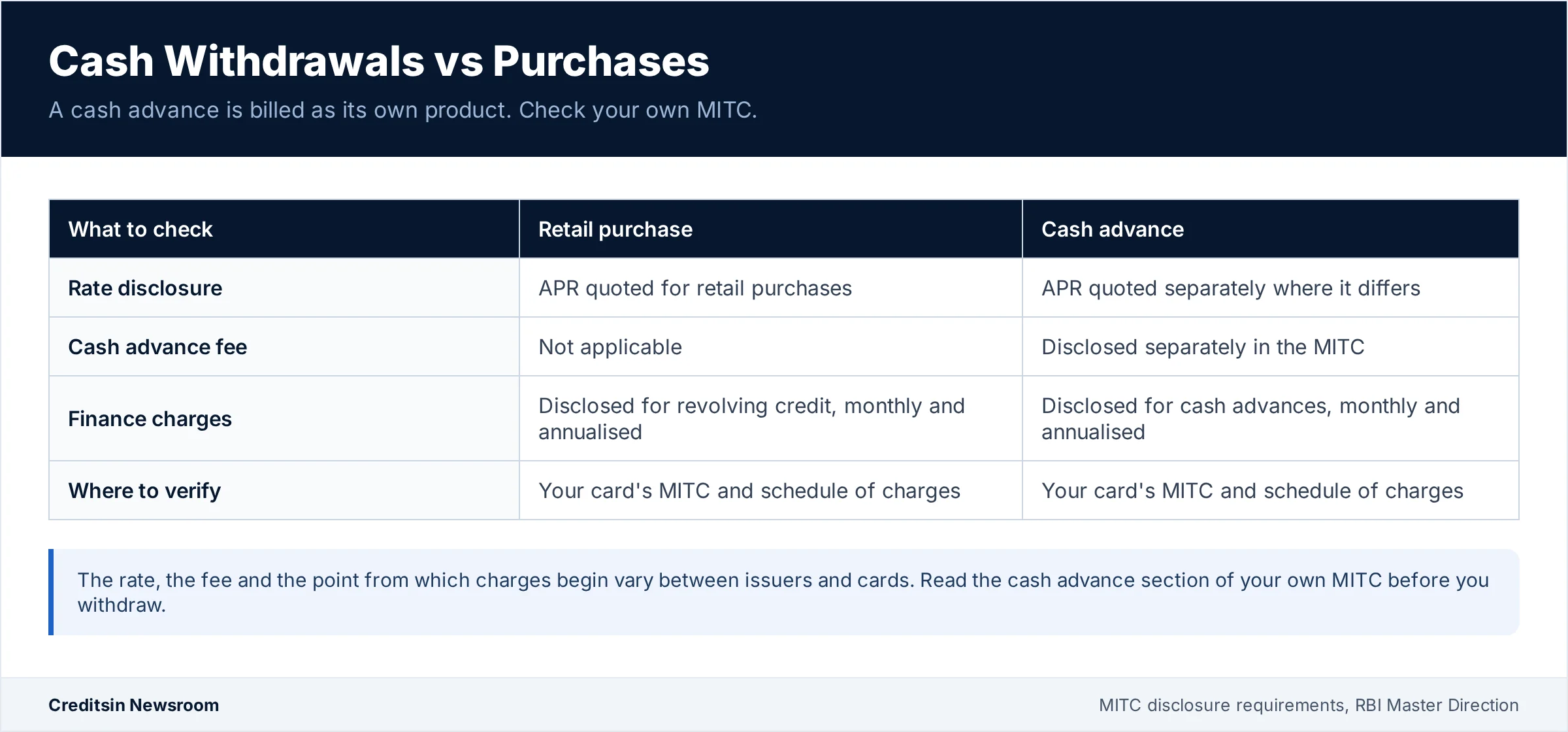
    Comparison of what the MITC discloses for retail purchases and for cash advances: rate disclosure, cash advance fee, finance charges and where to verify them
    Comparison of what the MITC discloses for retail purchases and for cash advances: rate disclosure, cash advance fee, finance charges and where to verify them

    Taking cash out on a credit card is a cash advance, and it is billed as its own product. The RBI requires the MITC to disclose the cash advance fee separately, along with finance charges for both revolving credit and cash advances, and overdue interest charges on a monthly and annualised basis. Issuers must also quote the APR for cash advances separately from retail purchases where it differs.

    The rate, the fee and the point from which charges begin vary between issuers and cards. Before you withdraw, read the cash advance section of your own MITC rather than assuming your purchase terms apply.

    Interest Quietly Cancels Your Rewards

    A card's benefits are worth calculating, but they sit on the wrong side of the ledger once you carry a balance.

  • Cashback and reward points. A cashback rate or reward rate earned on spending is a small percentage of the transaction. Finance charges run on the whole outstanding, month after month, until it is cleared.
  • Reward caps. Accelerated categories usually carry monthly caps and exclusions, so the earn rate you actually realise is lower than the headline rate.
  • Annual fee break-even and fee waiver. Work out the break-even on the annual fee, and check the fee waiver threshold your card sets. A fee waiver earned by pushing extra spending onto a revolving balance is not a saving.
  • Lounge access, forex and travel. Lounge visits and foreign currency spends are worth comparing on their own terms, including the forex markup, but none of them offset finance charges.
  • UPI, RuPay and fuel spends. RuPay credit cards linked to UPI and fuel transactions have their own reward and surcharge rules, and they follow the same principle: earnings are a fraction, interest is a multiple.
  • If you are revolving a balance, the highest-return financial move available to you is usually clearing the balance, not optimising the reward rate.

    Can Your Rate Change?

    It can, and the regulator anticipates it. The Master Direction states that where card-issuers charge interest rates which vary based on the payment or default history of the cardholder, there must be transparency in levying such differential interest rates. Issuers must also publicise the interest rates charged to various categories of customers.

    Note what that does and does not say. It recognises differential pricing and demands disclosure. It does not lay down when a rate must rise. If you want to know your position, check your latest statement and your issuer's published schedule of charges.

    What the RBI Does and Does Not Do

    The RBI does not fix credit card interest rates. It directs card-issuers to be guided by its instructions on interest rate on advances, requires that interest charged be justifiable having regard to cost and reasonable return, and requires each issuer to prescribe an interest rate ceiling in line with other unsecured loans as part of its board approved policy. Disclosure obligations sit alongside that: APR quoting, methodology with examples, and publication of rates.

    So the regulator governs the transparency and the ceiling framework. The actual number on your card is your issuer's commercial decision.

    How to Avoid Paying Credit Card Interest
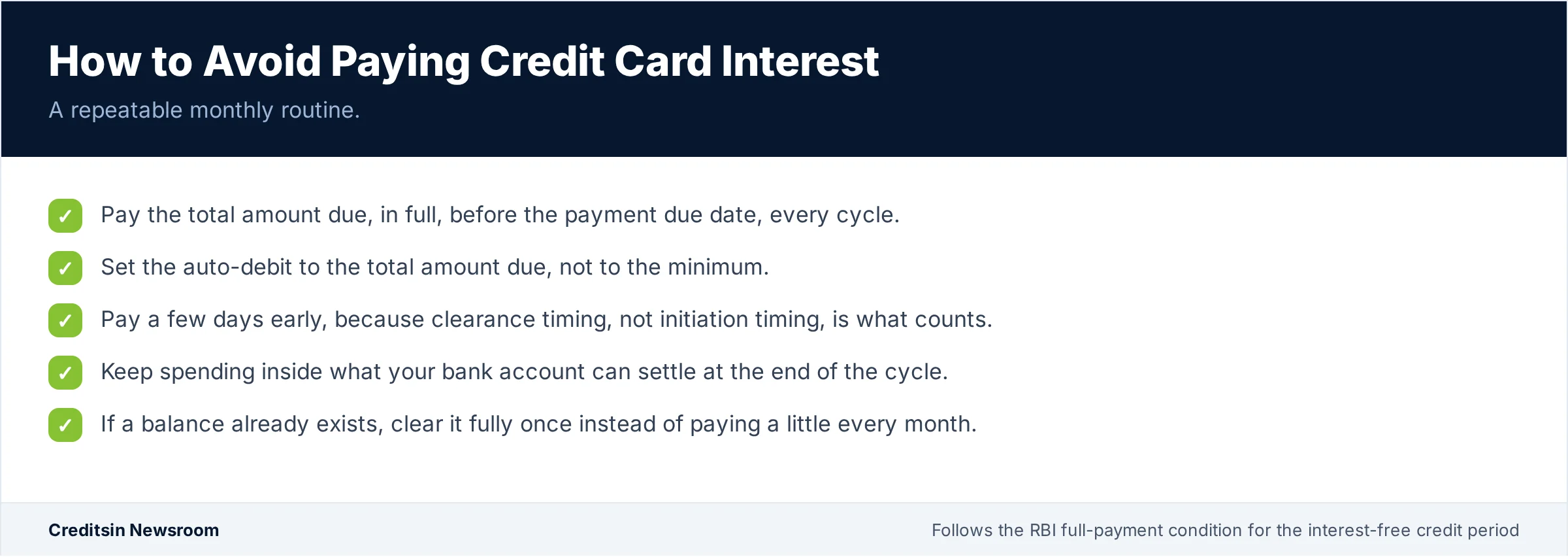
    Checklist for avoiding credit card interest: pay the total amount due in full before the due date, set auto-debit to the total, pay a few days early, spend within what the bank account can settle, and clear an existing balance in one go
    Checklist for avoiding credit card interest: pay the total amount due in full before the due date, set auto-debit to the total, pay a few days early, spend within what the bank account can settle, and clear an existing balance in one go
  • Pay the total amount due, in full, before the payment due date, every cycle.
  • Set the auto-debit to the total amount due, not to the minimum.
  • Pay a few days early, because clearance timing, not initiation timing, is what counts.
  • Keep spending inside what your bank account can settle at the end of the cycle.
  • If a large purchase will not clear in one cycle, check the EMI conversion terms and eligibility on your card before you spend, rather than after the bill arrives.
  • If a balance already exists, clear it fully once instead of paying a little every month.
  • Common Mistakes to Avoid

  • Treating the Minimum Amount Due as the bill.
  • Assuming interest starts from the due date, when it can run from the transaction date.
  • Believing new purchases are still interest-free while an old balance is outstanding.
  • Using a generic rate found online instead of the rate in your own MITC.
  • Withdrawing cash on the card without reading the cash advance terms.
  • Chasing rewards or a fee waiver while carrying a revolving balance.
  • Paying on the due date through a slow channel and being credited a day late.
  • Frequently Asked Questions

    Common questions on finance charges, the grace period and minimum payments are answered in the FAQs below.

    Official Sources

  • Reserve Bank of India, Master Direction on Credit Card and Debit Card - Issuance and Conduct Directions, 2022, including the Annex illustration and FAQs.
  • ICICI Bank, credit card interest rates guidance.
  • IDFC FIRST Bank, credit card interest rate guidance.
  • Your card's Most Important Terms and Conditions and the issuer's current schedule of charges.
  • Disclaimer

    This article is for educational purposes only and does not constitute financial advice. Rates, fees and terms differ by issuer and card and change over time. Verify current terms with your card-issuer before making a financial decision.

    Creditsin News may earn a commission if you apply for a credit card through links on our site. This does not affect our editorial independence.

    Sources

    Creditsin News cites official regulators, lenders and government bodies for factual claims.

    1. RBI - Master Direction: Credit Card and Debit Card - Issuance and Conduct Directions, 2022
    2. ICICI Bank - Credit Card Interest Rates
    3. IDFC FIRST Bank - What is Credit Card Interest Rate

    Frequently asked questions

    When exactly does credit card interest start?

    Interest applies when you do not clear the total amount due by the payment due date. The RBI's Master Direction states that in such a case the interest free credit period is lost and interest may be levied from the date of transaction on the outstanding amount, adjusted for payments and refunds, rather than on the total amount due. If you settle the entire outstanding on or before the due date, no finance charges arise on those purchases.

    What is the interest-free credit period?

    The RBI defines it as the period from the date of transaction to the due date of payment, during which payment can be made without interest, subject to the entire outstanding being paid on or before the payment due date. It is not a permanent card feature. The Master Direction requires issuers to explain in the MITC that the interest-free credit period is suspended if any balance of the previous month's bill is outstanding.

    Does paying the Minimum Amount Due stop interest?

    No. The RBI defines the Minimum Amount Due as the minimum part of the total bill you must pay so the bill is not treated as overdue. Finance charges still apply to the balance you carry. Billing statements must display a warning that making only the minimum payment every month results in repayment stretching over months or years, with compounded interest on your outstanding balance.

    What interest rate will my card charge?

    There is no single rate for India. Rates differ by issuer, by card variant and by transaction type. The Master Direction requires issuers to quote Annualized Percentage Rates for situations such as retail purchases, balance transfer, cash advances, non-payment of minimum amount due and late payment where these differ, and to explain the method of calculating finance charges with examples. Read your card's MITC and the issuer's current schedule of charges for your number.

    Do new purchases stay interest-free if I carry a balance?

    No. While a previous month's balance is outstanding, the interest-free credit period stands suspended, so new spends can attract finance charges too. The grace period returns only after the outstanding is cleared in full and a fresh cycle is settled on time.

    How is interest on cash withdrawals different?

    A cash withdrawal on a credit card is a cash advance and is billed on its own terms. The RBI requires the MITC to disclose the cash advance fee, finance charges for both revolving credit and cash advances, and overdue interest on a monthly and annualised basis, and requires the cash advance APR to be quoted separately where it differs. Check those sections of your MITC before withdrawing.

    Can my issuer charge me a different rate than someone else?

    Yes. The Master Direction recognises that some card-issuers charge interest rates which vary based on the payment or default history of the cardholder, and requires transparency where such differential rates are levied. Issuers must also publicise the interest rates charged to various categories of customers, so your applicable rate should be traceable to published terms.

    Does the RBI cap credit card interest rates?

    The RBI does not fix a specific rate. It directs card-issuers to be guided by its instructions on interest rate on advances, requires that interest charged be justifiable in relation to cost and reasonable return, and requires each issuer to prescribe an interest rate ceiling in line with other unsecured loans as part of its board approved policy, with the rationale auditable.

    About the author

    Nisha S

    Senior Finance Editor

    Nisha leads editorial coverage of credit cards, lending and RBI policy at Creditsin News, focusing on how rule changes affect everyday borrowers.

    editor@creditsin.com

    Creditsin News follows our editorial policy, fact-check standards and corrections policy.

    Not editorial

    Product listings are separate from our reporting. Creditsin may earn a referral fee if you apply through these pages.

    Editorial disclaimer

    This article is for information only and is not financial advice. Approval, rates, fees and features depend on bank/NBFC policies, eligibility and successful verification. Details were accurate at the time of review — always confirm current terms on the lender's official page.

    Commercial disclosure

    Creditsin may earn a referral commission when you apply for a product through links on this site. Commercial relationships never influence our editorial coverage, rankings or recommendations. Read our editorial policy.

    Spot an error? Write to corrections@creditsin.in or visit the newsroom contact page. About Creditsin News.